Blog Search
Why the Bank of Canada Opted To Hold Interest Rates on January 24th?
Today, the Bank of Canada kept its policy rate steady at 5% for the overnight rate, bank rate, and deposit rate, adhering to its quantitative tightening strategy. On a global scale, while the U.S. economy has shown surprising resilience, its growth is expected to cool in 2024, driven by declining consumer spending and business investment. Meanwhile, the euro zone is on the brink of a mild recession, adding to the global slowdown.
This global context is key to understanding the BoC's cautious decision making. Despite inflation falling in most countries, including Canada, policymakers remain concerned about persistent underlying inflation and the potential for renewed price pressures. They want to see further, sustained evidence of inflation retreating before considering rate cuts.
SLOWING INFLATION
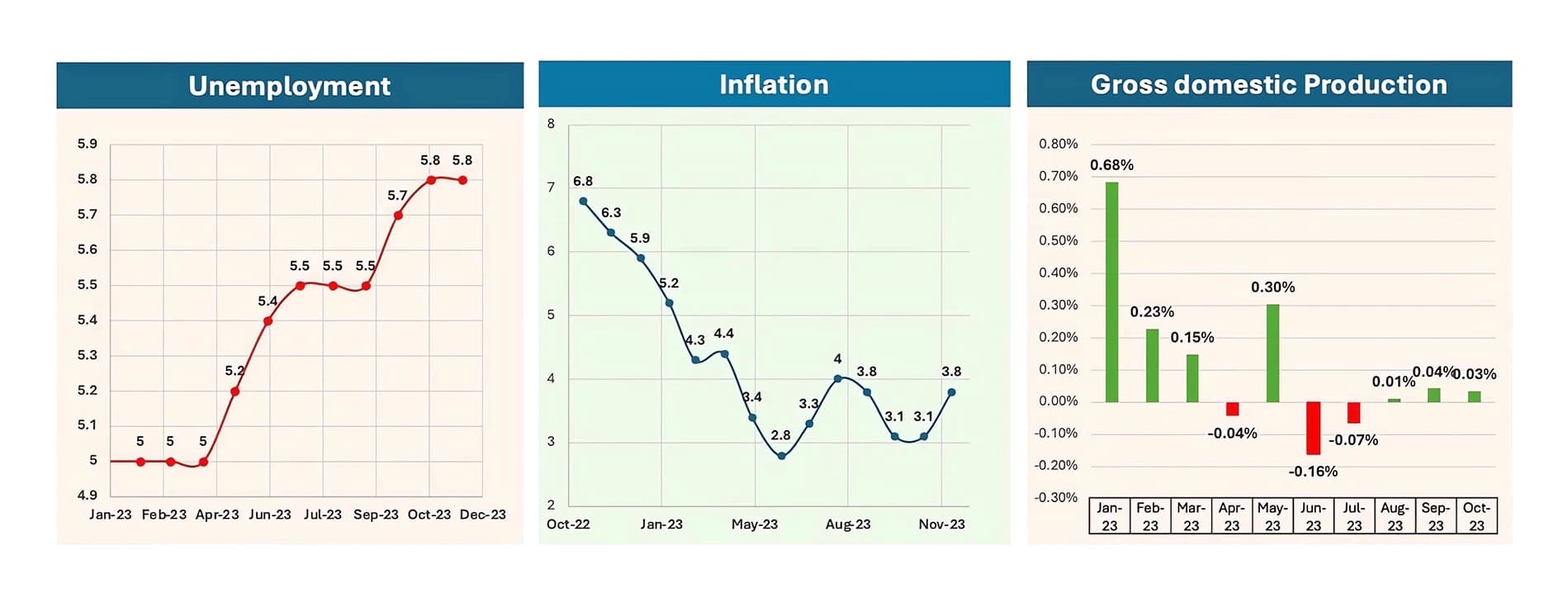
In the past year, the Consumer Price Index (CPI) recorded an inflation rate of 3.4%. The primary contributor to this inflationary trend, surpassing the targeted rate, remains the escalating housing costs. The Bank projects that inflation will hover around 3% in the initial half of the current year, gradually tapering off and retaining the 2% target by 2025. Although various components of the CPI and business pricing behavior indicate a diminishing impact of demand downturn on price pressures, core inflation measures are not exhibiting a consistent decline.
SLOWING GDP
Since mid-2023, the Canadian economy has entered a period of stagnation, with growth anticipated to be minimal throughout the first quarter of 2024. Faced with escalating costs and higher interest rates, consumers have scaled back their spending, while corporate investment has also witnessed a decline. The prolonged period of sluggish expansion has led to a convergence of supply and demand, indicating that the economy is operating with a modest surplus of supply.
Encouragingly, the labor market has shown signs of improvement, as job openings approach pre-pandemic levels, albeit with new employment being generated at a pace slower than the rate of population growth. Notably, wages continue to rise, with an increase in the range of 4% to 5%.
RAISING UNEMPLOYMENT
The Bank of Canada's decision to hold interest rates at 5% today offers a temporary reprieve for a labor market facing headwinds. With unemployment currently sitting at 5.8%, concerns exist about the potential impact of further rate hikes on job creation, particularly for vulnerable groups. The Bank will need to carefully navigate this balance between tackling inflation and protecting employment as it monitors incoming data in the coming months.
THE BOTTOM LINE
With the December unemployment rate at 5.8%, up by 0.8% since April, and combined with a stagnant GDP and a 3.4% annual inflation rate, it's clear that raising the interest rate would only strain the economy further. Our perspective aligns with the belief that maintaining the current trajectory could lead to a reduction in the inflation rate to 2-3% in the next 6 months. Should it fall below 2%, a modest policy rate cut by the Bank of Canada may not be an unreasonable expectation, providing a potential avenue for economic stabilization.


Blog Search
Popular Blogs
Popular Blogs
The trademarks MLS®, Multiple Listing Service® and the associated logos identify professional services rendered by REALTOR® members of CREA to effect the purchase, sale and lease of real estate as part of a cooperative selling system.