Blog Search
The Rate Cut Ripple Effect: Mortgage and Home Buying

The Bank of Canada’s decision to reduce its policy interest rate in July 2024 has sparked significant interest and speculation about its potential effects on the Canadian housing market. As homeowners and prospective buyers keep a close watch on these developments, it's important to understand exactly how these rate cuts could impact mortgages and the broader real estate landscape. This blog will break down the key effects of interest rate cuts on mortgages and what this means for Canadian homeowners.
Why Did the Bank of Canada Reduce Its Policy Interest Rate?
In July 2024, the Bank of Canada (BOC) made the strategic decision to reduce its policy interest rate by 0.25 basis points, bringing the overnight rate down to 4.50%. This move wasn’t made in isolation but was influenced by several economic factors.The most prominent reason was a noticeable decline in inflation, with the Consumer Price Index (CPI) dropping to 2.7% in April 2024. This decline in inflation signalled that the previously implemented interest rate hikes were achieving their intended effect of cooling down the economy.
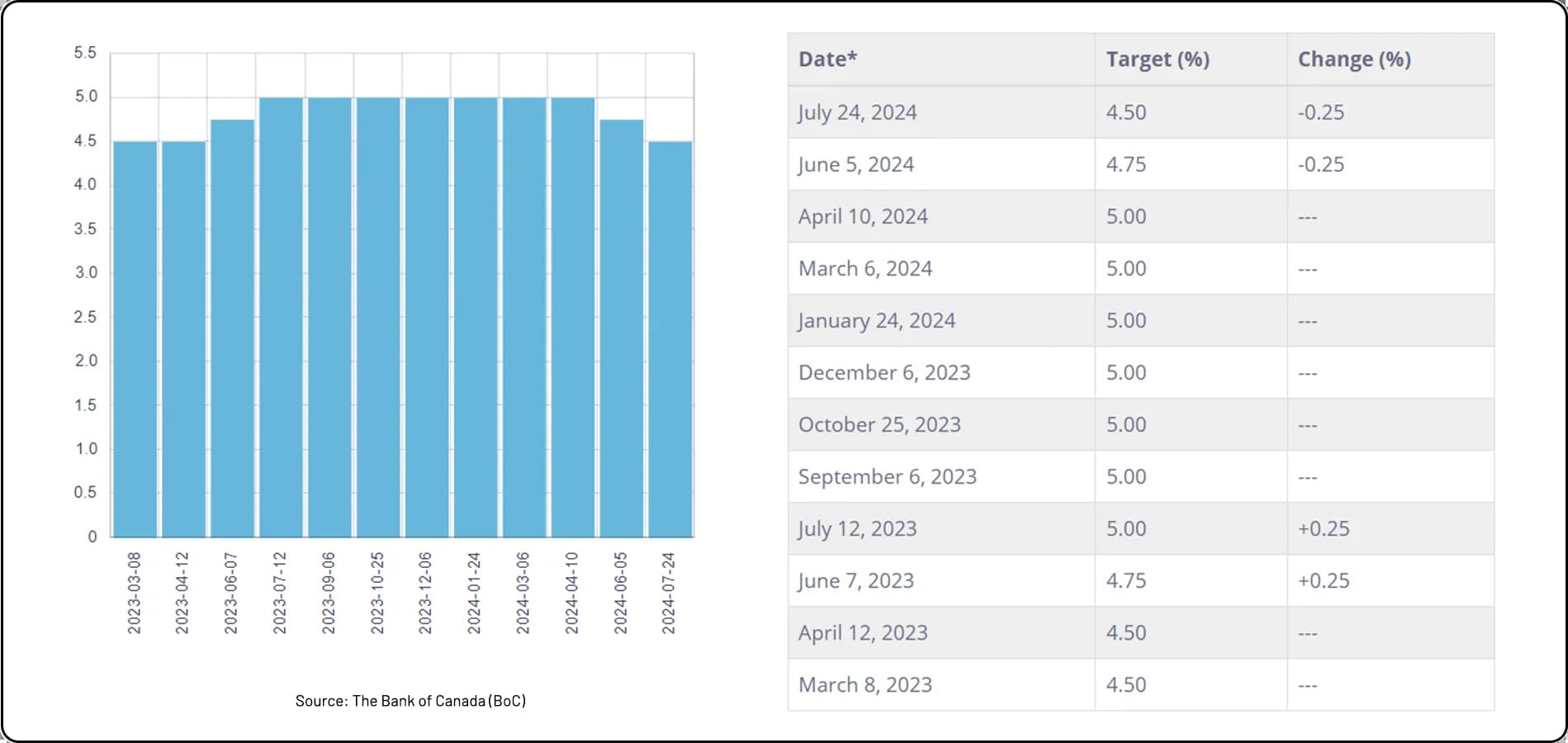
Additionally, the BOC’s preferred measures of core inflation showed a consistent downward trend, providing further confidence that inflation would continue moving toward the target of 2%. Another factor influencing the rate cut was the slower-than-expected economic growth in the United States, which suggested a possible economic slowdown on a global scale. To support the Canadian economy and provide financial relief, the BOC’s Governing Council concluded that monetary policy didn’t need to be as restrictive, leading to the rate-cut decision.
How do Lower Policy Rates Translate to Lower Mortgage Rates for Canadians?
When the BOC reduces its policy interest rate, it doesn’t automatically result in a proportional decrease in mortgage rates. The relationship between the policy rate and mortgage rates is not always straightforward. While there is an impact, it can take time for mortgage rates to adjust, and the extent of the adjustment isn’t always predictable.
In the weeks following the BOC’s rate cut, Canada’s mortgage landscape experienced some minor adjustments. Variable-rate mortgages, which are directly influenced by the BOC’s policy rate, started to see some reductions. However, fixed-rate mortgages, which are more closely tied to the Canadian 5-year bond yield, did not experience an immediate impact.
How Variable-Rate Mortgage Rates Will Change?

Variable-rate mortgages are more sensitive to changes in the BOC’s policy rate. When the BOC lowers its rate, as it did in July, the interest rates on variable-rate mortgages typically decrease. This decrease translates into lower monthly payments for borrowers. For every 25-basis-point reduction, homeowners with variable-rate mortgages can expect to pay approximately $15 less per $100,000 of mortgage.
This reduction is beneficial not just because of the immediate decrease in monthly payments but also because more of the payments are applied to the principal, helping homeowners pay off their mortgages more quickly. Adjustable-rate mortgage holders, in particular, will see these reductions reflected in their payments almost immediately.
How Fixed-Rate Mortgages Will Change?
Fixed-rate mortgages, unlike variable-rate mortgages, do not change once they are issued. This means that if you already have a fixed-rate mortgage, the BOC’s recent policy rate cut will not directly impact your current mortgage payments. However, the rate cut does influence the rates for new fixed-rate mortgages and mortgage renewals.
The interest rates for new fixed-rate mortgages are closely tied to Canada’s five-year bond yield. If the yield on the five-year bond decreases, lenders typically offer lower rates for new fixed-rate mortgages. Conversely, if the yield rises, so do the interest rates. Following the BOC’s rate cut, it is expected that the five-year bond yield may decrease, which could result in lower rates for new fixed-rate mortgages in the near future.
Understanding the Impact of Interest Rate Reductions on Mortgage Renewals

A significant number of Canadian homeowners will be renewing their mortgages in 2024 and 2025—approximately 2.2 million mortgages, representing about 45% of all mortgages in the country. Most of these homeowners will face higher mortgage rates at renewal compared to their previous term. However, the recent rate cuts by the BOC will help to ease some of the financial strain associated with renewing at higher rates.
For example, if you have a $500,000 mortgage with an interest rate of 2.20%, your monthly payment would be around $2,166. Upon renewal at today’s best five-year fixed rate of 4.54%, your payment would rise to approximately $2,778, an increase of $600 per month. Although this is a significant jump, the recent rate cuts are expected to prevent rates from climbing even higher, offering some relief to renewing homeowners.
Interest Rate Reductions and the Prospective Homebuyer
The recent interest rate cuts are a positive development for prospective homebuyers. Over the past two years, the BOC’s series of rate hikes significantly impacted affordability and mortgage options, leading to a more challenging market for buyers. The recent rate decrease signals the beginning of a potential trend of lowering rates, which could enhance buying power and affordability for those looking to enter the housing market.
Additionally, the interest rate hikes of the past two years have led to an increase in housing supply as some homeowners found it challenging to keep up with rising mortgage payments. This shift has moved many Canadian real estate markets into buyer’s market territory, where there is more supply than demand, giving buyers an edge for the first time in decades.
The bottom line
The Bank of Canada’s recent interest rate cuts mark a potential turning point in the Canadian housing market. While the immediate effects on mortgage rates may vary depending on whether you hold a variable or fixed-rate mortgage, the overall trend suggests a more favourable environment for both homeowners and prospective buyers. As rates continue to adjust, Canadians can expect to see gradual reductions in mortgage-related costs, making homeownership more accessible and manageable in the coming years.


Blog Search
Popular Blogs
Popular Blogs
The trademarks MLS®, Multiple Listing Service® and the associated logos identify professional services rendered by REALTOR® members of CREA to effect the purchase, sale and lease of real estate as part of a cooperative selling system.