Blog Search
Ontario’s Housing Market Update: Buyers in Control As Confidence Builds

As Ontario moved through September 2025, the province’s housing market continued to tilt decisively in favor of buyers. With elevated inventory levels, modest price rebounds, and renewed optimism following the Bank of Canada’s latest rate cut, the real estate landscape is entering a new phase — one where balance may slowly begin to return, but buyers still hold the upper hand.
For the first time in nearly two years, both data and sentiment are aligning to show a clear trend: buyers are back in control.
A Market Defined by Abundant Choice
Across Ontario, 12,497 properties changed hands in September, representing a 5.25% month-over-month increase in sales. On the surface, this marks a healthy rebound in activity, but a closer look tells a more nuanced story.
New listings rose by 6.38% during the same period, pushing inventory levels higher and ensuring that supply continues to outpace demand. The result is a sales-to-listings ratio of just 38%, which firmly places Ontario in buyers’ market territory — a condition that gives purchasers more negotiation power and forces sellers to be more flexible on price and conditions.
“We’re clearly in a phase where buyers have regained control,” says Manoj Karatha, Broker of Record at The Canadian Home. “Inventory levels are high, and sellers are having to meet the market rather than set it. With a sales-to-listings ratio under 40%, we can confidently call this a buyers’ market across most of Ontario’s housing markets. The Bank of Canada’s recent rate cut has helped confidence, but prices are still adjusting — which gives first-time home buyers a real window of opportunity.”
Karatha’s assessment aligns closely with the latest data. Buyers now have the advantage of time — the ability to browse, compare, and negotiate — a luxury that was rare during the rapid-fire housing market conditions in Canada of 2021 and 2022. Sellers, on the other hand, are facing a new reality: properties need to be priced competitively and presented strategically to stand out in a crowded marketplace.
Read also: Don’t Buy or Sell in Canada Until You Read This 2025 Capital Gains Tax Guide
Price Trends: Gradual Gains, But Still Below 2024 Levels
The average home price in Ontario reached $850,722 in September, reflecting a 3.5% monthly increase. However, prices remain 3.5% lower year-over-year, underscoring that while recovery is underway, the market is still in the process of finding equilibrium.
Detached homes led the province’s rebound with an average price of $956,000, up 4% month-over-month as more families and move-up buyers re-entered the market post-rate cut. Even so, detached values remain about 4% below last year’s levels, a reminder that broader affordability pressures are still at play.
Semi-detached properties showed the strongest month-over-month growth at 5.3%, yet remain 6.1% below last year, suggesting that while short-term confidence is improving, buyers are still price-conscious.
Townhouses have remained relatively steady, posting 0.2% growth to $766,000, as affordability-minded buyers continue to find this category appealing. Meanwhile, condominiums — long a favorite among investors — are showing slower signs of life. Average condo prices climbed 3.1% month-over-month to $611,000, but sales volumes are down nearly 19% year-over-year, indicating that urban markets remain oversupplied.
GTA Snapshot: Early Signs of Stabilization
The Greater Toronto Area (GTA) continues to be a critical driver of provincial trends. In September, the GTA recorded an average home price of $1.07 million, up 2.6% from August, but still 4.5% lower year-over-year.
Sales volume jumped 11.7% month-over-month, signaling that lower borrowing costs and improving consumer confidence are beginning to thaw activity after a sluggish summer. Detached homes once again led the charge, with average prices climbing 3.2% to $1.38 million, supported by renewed buyer optimism.
Condos and townhouses, however, continued to underperform, showing 0.99% and -2.75% changes respectively. Elevated listing volumes have given buyers more options, and many are choosing to wait or negotiate harder rather than rush into a deal.
Regional Highlights: A Tale of Contrasts
Beyond the GTA, Ontario’s regional housing markets told a story of contrasts — some surging, others cooling after a strong start to the year.
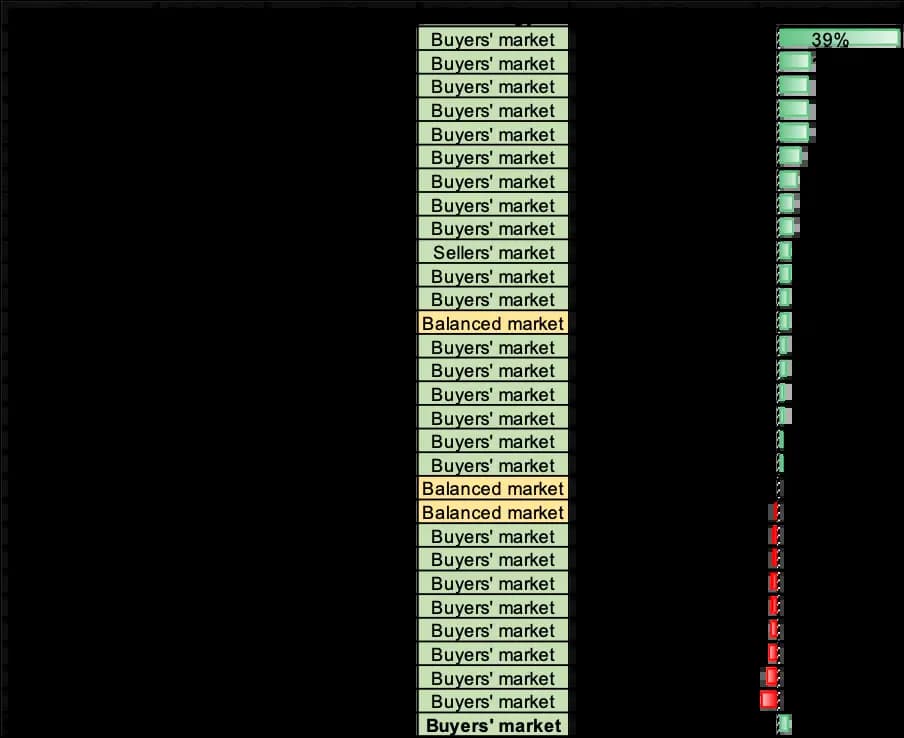
Cambridge emerged as the month’s standout performer, registering a remarkable 39% price surge. Nearby Kitchener and Kawartha Lakes also saw healthy 9% gains, driven by relocation demand and affordability advantages compared to major urban centers.
In Toronto and Etobicoke, prices rose between 9% and 10%, signaling a modest rebound in urban confidence, especially within the detached and semi-detached segments.
By contrast, higher-end suburban markets like Oakville (-6%) and Burlington (-3%) showed notable cooling. These areas, which led much of the price appreciation earlier in 2025, appear to be undergoing a correction as buyers shift toward more affordable locations.
Markets such as Ottawa, Ajax, and Clarington are showing early signs of balance, with sales-to-listing ratios between 46% and 51% — suggesting that with a slight reduction in inventory, they could shift toward a more neutral market later this year.
The Economic Backdrop: Rate Cuts, Inflation, and What’s Next
The broader macroeconomic environment continues to influence housing trends in meaningful ways. On September 17, the Bank of Canada reduced its policy rate by 0.25%, bringing it to 2.5% amid signs of slowing economic growth and easing inflation.
Inflation currently sits at 1.9%, below expectations — a signal that the central bank has room for further easing if economic momentum remains weak. The next rate announcement is scheduled for October 29, and markets are already anticipating additional cuts that could further boost housing confidence into the winter months.
“The recent 25 basis point rate cut, bringing rates down to 2.50%, has definitely fueled this momentum,” notes Robin Cherian, CEO of The Canadian Home. “And with two more cuts expected later this year, the market could heat up even further heading into winter. If you’re a seller, it may be smart to hold off — home values are likely to appreciate more in the long run. But for buyers, this is a fantastic time to step in and start exploring your options.”
Cherian’s insight captures the dual dynamic unfolding across Ontario: buyers are acting now to secure favorable deals, while many sellers are watching closely, waiting for the next signal that prices are on a sustained upward path.
Understanding the Market Shift
To put these trends in perspective, it’s helpful to understand what constitutes a buyers’ market versus a sellers’ market.
A buyers’ market occurs when housing supply exceeds demand — when there are simply more listings than active buyers. In such conditions, homes take longer to sell, price reductions become common, and buyers gain stronger negotiating power. A sales-to-listings ratio below 45% is the typical threshold.
Conversely, a sellers’ market arises when demand outpaces available supply, usually reflected by a ratio above 60%. Homes in these markets tend to sell quickly, often triggering multiple offers and bidding wars.
Ontario’s 38% ratio is a clear signal that buyers remain in the driver’s seat — at least for now.
Read also: Ontario Housing Trends 2025: The Best Time for First-Time Buyers?
What Lies Ahead
Looking ahead to the final quarter of 2025, Ontario’s housing market appears poised for a period of measured recovery. The September data suggests that prices may have found a soft floor, particularly in family-oriented segments like detached and semi-detached homes.
However, oversupply in condos and lingering affordability constraints will likely keep the market from swinging back into sellers’ territory too quickly. Much will depend on the Bank of Canada’s next moves and how quickly consumer confidence continues to improve.
For first-time home buyers, this remains one of the most promising environments in recent years — a chance to purchase with less competition, greater choice, and better negotiating terms.
For sellers, patience may be key. As Robin Cherian emphasized, those who can afford to wait may see stronger appreciation ahead if interest rates continue to fall and buyer confidence strengthens further into winter and early 2026.
Conclusion
Ontario’s real estate market in September 2025 stands at a crossroads. The data points to a buyer-led landscape, but one that’s slowly edging toward renewed stability. With borrowing costs declining, prices showing early signs of rebound, and market sentiment turning cautiously optimistic, the coming months could set the tone for a more balanced year ahead.
For now, the message is clear: buyers have the upper hand, but those who act strategically — on both sides of the table — can position themselves well for what comes next.


Blog Search
Popular Blogs
Popular Blogs
The trademarks MLS®, Multiple Listing Service® and the associated logos identify professional services rendered by REALTOR® members of CREA to effect the purchase, sale and lease of real estate as part of a cooperative selling system.